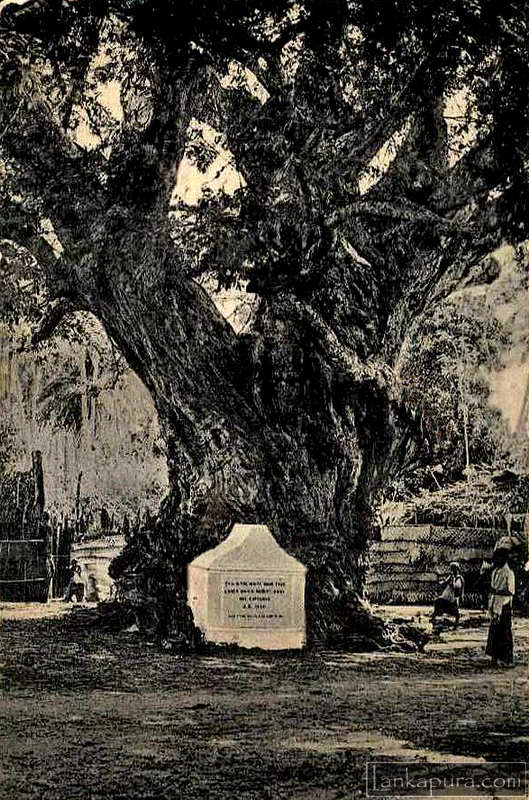
White Man’s Tree at Koddiyar, South of Trincomalee Ceylon #IMG720
Trincomalee where Mahaweli Ganga empties itself. The French were, in 1672, granted permission by the Kandyan king to erect a fort here. Later the Dutch, under Admiral Goens, attacked and defeated the French, who evacuated the fort and set sail for the Coromandel coast.
The ‘White Man’s Tree’, where Robert Knox was taken prisoner in 1660.
The two Knoxes (Robert Knox, Snr. and his son Robert Knox, Jnr) sailed on board ship “Anne” for Persia On January 21, 1658 under the British East India Company. They suffered the loss of the ship’s mast and sails were damaged in a storm on 19 November 1659, forcing them to put ashore near Kottiar Bay (more correctly Koddiyar or Cottiar), South of Trincomalee (estuary of Mahaweli Ganga, Trincomalee) Ceylon, now Sri Lanka.
When King Rajasinghe II of Kandy (1629-1687 A.D.) heard of their arrival he sent them gifts and invited them to come ashore. They were received by the Disawe of the district. But later, while Robert Knox Snr, was resting under a tamarind tree the king’s men took him captive. The ship was impounded and sixteen of the crew were taken captive.
Ship crew was forbidden from leaving the kingdom, but they were treated fairly leniently; the younger Knox was able to establish himself as a farmer, moneylender and pedlar. Both men suffered severely from malaria and the elder Knox died in February 1661 after a long illness.
Robert Knox eventually escaped with one companion, Stephen Rutland, after nineteen years. The two men were able to reach Arippu, a Dutch fort on the north-west coast of the island. The Dutch transported him to Batavia (now Jakarta), from where he was able to return home on an English vessel, the “Caesar” in September 1680.
During the voyage Knox wrote the manuscript of “An Historical Relation of the Island Ceylon”, an account of his experiences on Ceylon, which was published in 1681. The book was accompanied by engravings showing the inhabitants of Ceylon, their customs and agricultural techniques. It attracted widespread interest at the time and made Knox internationally famous, influencing Daniel Defoe’s “Robinson Crusoe”. It is one of the earliest and most detailed European accounts of life on Ceylon and is today seen as an invaluable record of the island in the 17th century.
In later years, this tree where Robert Knox Snr. was captured was marked with a memorial tablet. On it was carved the words: “This is the Whiteman’s tree under which Robert Knox, captain of the ship ‘Anne’ was captured”. The stone tablet was placed in 1893 and was maintained for a number of years by the Government Archivist. But the cyclone that lashed Trincomalee in the 1970s brought the tree down. The stone tablet that stood near the foot of the tree was taken to the Colombo National Museum to be preserved for posterity.
References:
Robert Knox (sailor)
Robert Knox: Ancient Ceylon’s most famous British captive
This famous Tamarind tree was dead recently somewhere in the 90’s or early 2000’s or during 2004 tsunamis – I do not remember well. If the date of its death is included in this write-up, it will be more useful to the reader as a reference.
Robert Knox Jnr. has recorded detailed historical accounts about the 17th century of Sri Lanka. Knox was in captive in Sri Lanka (with 16 English men) for 29 years. His book titled “Historical Relations of the Island Ceylon” is the only historical record which contains reliable facts and true description on the Govenment, administration, judiciary, culture, customs, livelihoods, agriculture, cast structure, life styles of noble people and so many.
I sggest to form a study circle on Robert Knox and his works.